
El Salto, Boquete, Panama
ABOUT
El Salto Premium Coffee
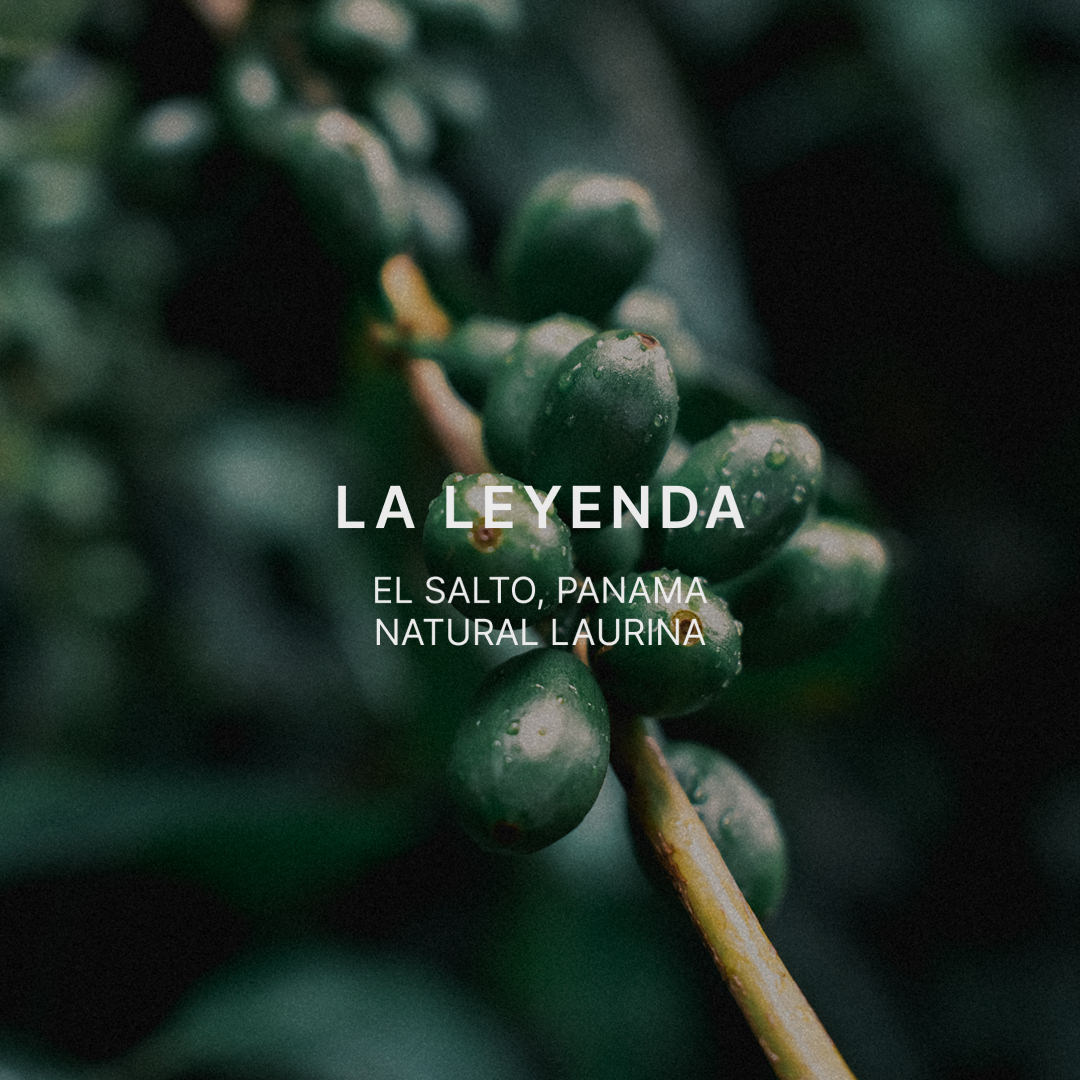
El Salto is the cool high ground above Boquete, on the road that climbs toward the top of Volcán Barú, Panama's highest mountain. Temperatures here run between 13 and 22 °C. The Suárez family's coffee roots in Boquete go back to 1900, when Abdeliat Suadi arrived from Bethlehem and the locals renamed him Domingo Suárez. In 1948 his youngest son Vidal and Vidal's wife Eira Gutiérrez de Suárez started their own farm in El Salto. Their first plantation was Camiseta, planted with Typica, and over the years they bought neighbouring land until they were among the five largest producers in Boquete. Today two of their six children, Carlos and Laura Suárez, run the farms as Grupo Vicala under the El Salto Premium Coffee name, across Camiseta, Los Limones and Doña Eira, between 1500 and 1780 masl. Among other varieties they grow Typica, Yellow Catuai, Laurina and Geisha. Our lots come from Camiseta at 1780 masl. Every pick is floated and sorted by hand, dried slowly in the shade on African beds with the mountain breeze, and finished in a static dryer at low heat.
Laurina
Laurina is one of the rare coffees with a real island story. In the early 1800s a plantation manager named Leroy, working for Auguste Pajot in Sainte Marie on the island of Bourbon, noticed trees that looked nothing like the rest. They were small and shaped like a pyramid, with short dark leaves and narrow, pointed beans. The locals called it Bourbon Pointu, and planting spread across the island after cyclones and drought destroyed the old coffee in 1806 and 1807. The same quirk that makes the plant so compact also leaves it with around 0.6 percent caffeine, about half of a typical arabica. That is lovely in the cup and hard in the field, because with so little caffeine the tree has less defence against insects, and it yields very little. When sugar cane took over the island in the second half of the 19th century, Laurina slowly disappeared, and after the Second World War only a few trees survived in Creole gardens. In 2002 the Réunion region and CIRAD set out to save it, and since then a handful of farms in Costa Rica, Nicaragua and Panama have taken it up as well. For us it is one of the most elegant coffees there is, quiet and sweet, with a creamy texture and almost no bitterness.
Natural
The natural process is the oldest way of preparing coffee, dating back to the earliest days of the crop in Ethiopia and Yemen. The whole cherry is dried intact, with the skin, pulp, and sticky mucilage all left on the bean, so as the fruit slowly dries it feeds its sugars and aromas straight into the seed. Getting it right takes patience and constant attention, as the cherries have to be turned regularly on raised beds over many days to dry evenly and avoid faults. Done well, the natural process gives coffees their heavy body, deep berry and jam fruit, and big, wine like sweetness.
Brewing recipes
Simple ways to brew with SOLO & SOLO SPIN

SOLO
This is the classic pour-over style.
You control the brew through your pouring technique, water temperature, and flow speed.
Each pour helps guide the extraction, from soaking the coffee evenly at the beginning to building sweetness in the middle and finishing clean at the end.
This method is best when you want a clean, balanced cup with direct control over the pour.
Best for a clean, balanced cup with direct control over the pour.
SOLO SPIN
This is a hybrid brewing style.
SOLO SPIN uses a valve to control when the coffee is soaking and when it is draining.
When the valve is closed, the coffee stays in contact with the water, like immersion brewing.When the valve is open, the water flows through the coffee, like percolation brewing.
This method gives you more control over contact time, sweetness, body, and clarity.It is best when you want a consistent, balanced cup with both the roundness of immersion and the clean finish of pour-over.
Best for a consistent, balanced cup — the roundness of immersion with the clean finish of pour-over.
SOLO
SOLO POUR OVER METHOD
This method is simple, clean, and easy to repeat.
Coffee does not extract all at once. Different flavors come out at different moments during the brew.
The first pour helps water reach all the coffee evenly.
The middle pours build sweetness, body, and balance.
The final pour should be gentle.
This helps avoid bitterness, dryness, and heavy flavors.The goal is not to push extraction harder.
The goal is to keep the cup sweet, clean, and structured.
3 POUR EXTRACTION
This method is best for a clean, sweet, and balanced cup.
At 0:00, pour 80g of water at 93°C.
Make sure all the coffee is fully wet. There should be no dry spots.
At 0:40, pour another 80g of water at 93°C.
This second pour builds sweetness and balance.
At 1:20, pour the final 80g of water at 85°C.
Pour gently and let the brew finish naturally.
4 POUR EXTRACTION
This method is best when you want more body and more structure.
At 0:00, pour 60g of water at 93°C.
Fully soak all the coffee.
At 0:30, pour another 60g of water at 93°C.
This helps build sweetness.
At 1:00, pour another 60g of water at 93°C.
This develops more body and structure.
At 1:30, pour the final 60g of water at 85°C.
Keep this pour gentle and centered.
8G DOSE EXTRACTION
Use this recipe when brewing rare, expensive, or limited coffees.
It is designed for a smaller cup, while keeping the same brewing idea.
Coffee: 8g
Water: 120g
Ratio: 1:15
Grind: Medium-coarse
minerals: 40-80 ppm
For the 3 pour method, pour 40g at 0:00, 40g at 0:40, and 40g at 1:20.
Use 93°C for the first two pours and 85°C for the final pour.
For the 4 pour method, pour 30g at 0:00, 30g at 0:30, 30g at 1:00, and 30g at 1:30.
Use 93°C for the first three pours and 85°C for the final pour.
This small dose method is useful when you want to enjoy a high-end coffee without using too much coffee at once.
SOLO SPIN
SOLO SPIN BREW METHOD
SOLO SPIN gives more control during brewing.
When the valve is closed, the coffee is soaking.
When the valve is open, the coffee is draining.
This lets you combine immersion and percolation in one simple brewer.
Immersion helps water reach the coffee evenly.
Drainage keeps the cup clean and clear.
The result is a sweet, balanced, and consistent brew.
TWO PHASE MOISTURE EXTRACTION
JACKIE'S COMPETITION RECIPE
This recipe was designed to be simple, consistent, and forgiving.
It has two phases.
The first phase is penetration.
This helps water reach every coffee particle evenly.
The second phase is development.
This slows the extraction down and builds sweetness, texture, clarity, and balance.
Coffee: 14g
Water: 200ml
Ratio: 1:14
minerals: 80 ppm
At 0:00, close the valve.
Add 100ml of water at 94°C.
Let the coffee soak.
At 1:00, open the valve and let it fully drain.
At 1:20, close the valve again.
Add 100ml of water at 80°C.
Let the coffee soak again.
At 2:20, open the valve and let it fully drain.
This is the most forgiving SOLO SPIN recipe and is perfect for daily brewing.
PIP EXTRACTION
Percolation. Immersion. Percolation.
Triple Pulse Brewing is a SOLO SPIN recipe.
It starts with percolation, then moves into immersion, and finishes with percolation again.
This creates a cup that is clean, sweet, and expressive.
Coffee: 14g
Water: 200ml
Ratio: 1:14
minerals: 80 ppm
At 0:00, start with the valve open.
Add 50ml of water at 80°C.
Let the water flow through the coffee.
This first percolation stage helps open the coffee and bring out aroma and clarity.
At 0:30, close the valve.
Add 100ml of water at 94°C.
Let the coffee soak.
This immersion stage builds sweetness, body, and balance.
At 1:00, open the valve.
Add the final 50ml of water at 80°C.
Let the brew drain completely.
This final percolation stage refines the cup and keeps the finish clean.
This recipe is best when you want a cup with both sweetness and clarity.
It gives the roundness of immersion, but still keeps the clean finish of percolation.