
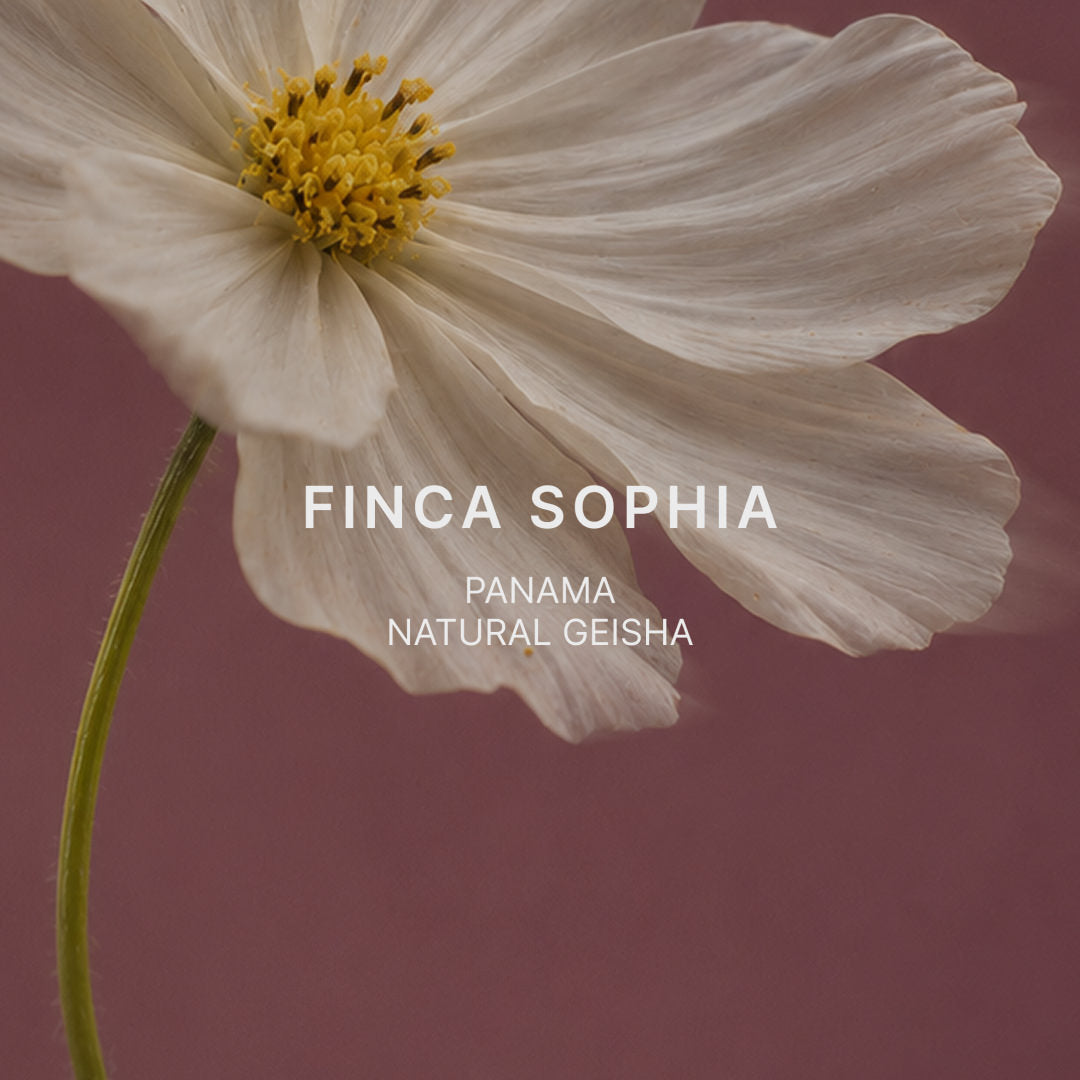
The season
2026
The year the farm
almost had nothing
Finca Sophia sits above Nueva Suiza on the edge of the Parque Internacional La Amistad. Willem Boot planted it in 2008 with the founders of Equator Coffees, on a worn out vegetable farm, to find out how high coffee could go in Panama. It took eight years before there was a harvest worth selling.
Up there the soil stays cold, so what falls on it breaks down slowly and the ground never gets rich. The shape of the land and the cloud keep the sun off. Everything grows slowly, which is the whole point.


The 2026 harvest was extraordinarily small, less than 10% of our 2025 production and totaling under 200 kilograms across all lots.
Finca Sophia

the rest is forest

They run on a rough three year rhythm. One large harvest, one very small one, then a year of recovery, and weather can stretch that into two small years back to back. Nature sets the limits, they say, and the goal was never to maximise production.
Nueva Suiza
Tierras Altas

How it
was sold
The entire harvest,
released once
With almost nothing to sell, they did something they had not done before. Nearly eighty percent of the lots came in under five kilos. Splitting that quietly between long standing partners would have meant choosing who went without.

A single auction was the most transparent and equitable way to share the harvest.
Finca Sophia
Between ninety five and ninety eight percent of everything the farm grew in 2026 went into that one sale. Nothing was held back for long standing partners, nothing kept for competition.
They sat out Best of Panama for the first time in years. Entering would have meant blending five to seven nano lots together to make one competition entry, and the individuality of those tiny lots was the whole character of the harvest.
Forty four lots. A hundred and seventy kilograms. Released on one evening in July under the name A Singular Offering. Four hundred and eighty one bids landed on this one.

In the
box
Every lot leaves
the farm documented
Each release carries a signed record naming the house it was entrusted to. Ours says Mazelab Coffee. Three bags of one kilogram and one of a half.
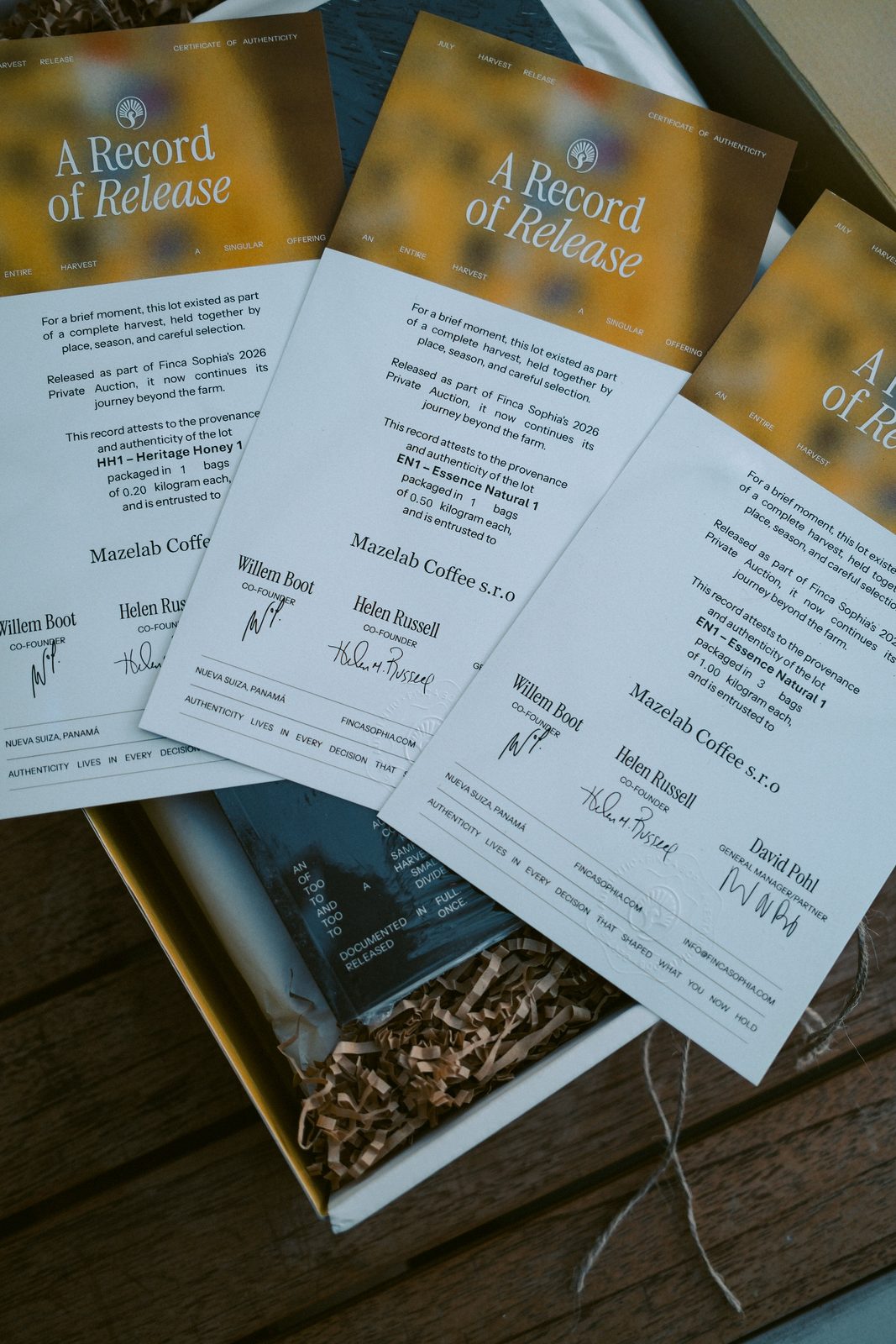
as co-founders, and David Pohl as general manager
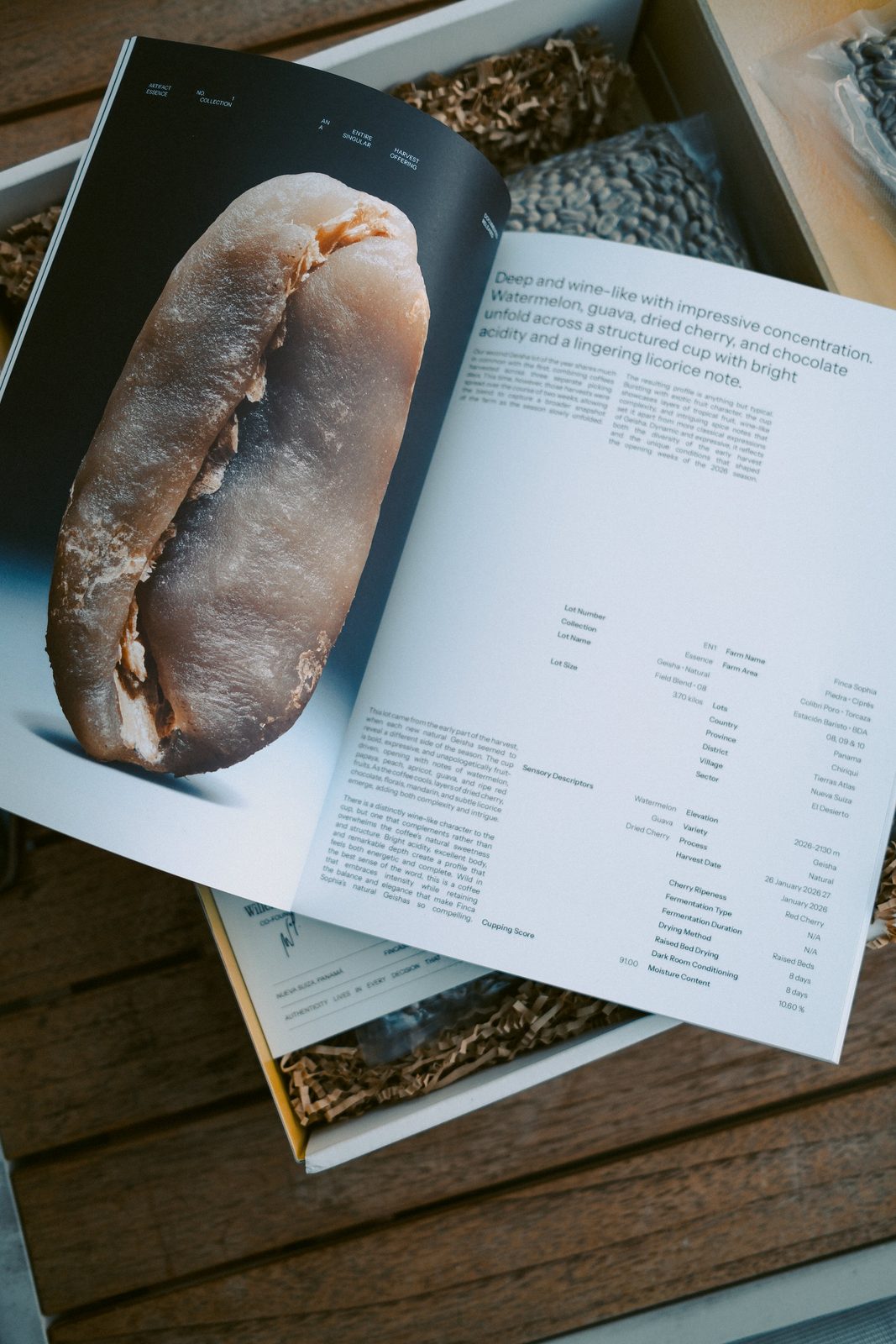
with its own cupping sheet
None of this exists anywhere online. The farm does not publish the book, and no one else who bought a lot has shown theirs.
How it
was dried
Eight days on beds,
eight in the dark


The lot
EN1
Essence Natural 1
As recorded in the release book
- Collection
- Essence
- Lot name
- Geisha · Natural · Field Blend · 08
- Lots
- 08, 09 & 10
- Village
- Nueva Suiza
- District
- Tierras Altas, Chiriquí
- Sector
- El Desierto
- Elevation
- 2026 to 2130 m
- Variety
- Geisha
- Process
- Natural
- Harvest
- 26 and 27 January 2026
- Cherry
- Red cherry only
- Drying
- Raised beds, 8 days
- Conditioning
- Dark room, 8 days
- Moisture
- 10.60 %
The farm
six plots
This lot came off six
pieces of hillside
Half of the twenty hectares is planted. The rest is forest, or on its way to being forest, sitting as a buffer between the national park and the farmland around it.


The cup
two readings
Finca Sophia · cupped 91.00
Deep and wine like with impressive concentration. Watermelon, guava, dried cherry and chocolate unfold across a structured cup with bright acidity and a lingering licorice note.
Mazelab · roasted on the S7X
Raspberry and passion fruit, with rose through the middle and honeycomb at the end. Naturals from this elevation come out unusually clean, closer to a washed coffee than a natural has any right to be.
At the
gate
We have stood at that gate. This is the most expensive coffee we have ever bought and we are not going to pretend otherwise. When it is gone it is gone.

ABOUT
Finca Sophia
Finca Sophia grows at the very edge of where coffee will still ripen, high in the misty highlands of Nueva Suiza above Volcán. It was founded in 2008 by Willem Boot with Helen Russell and David Pohl, who set out to test the limits of Geisha at extreme elevation. What was once a rugged cattle and vegetable plot has been replanted with native shade and Geisha, and today it stands among the highest and most exacting farms in Panama, a repeat Best of Panama winner whose lots have set world auction records. At beyond two thousand metres the cherry ripens painfully slowly, and that patience is where the farm's extraordinary clarity comes from.
Geisha
Geisha, also spelled Gesha, traces its roots to the forests of southwestern Ethiopia, where the original seed was collected in the middle of the twentieth century before travelling through research collections in Central America. For decades it was little more than a curiosity, until growers working at high altitude discovered how extraordinary it could taste. At its best it is unmistakable, with intense florality, a delicate tea like quality, bright citrus, and tropical fruit. The plants are slender and shy to yield and offer little disease resistance, so Geisha is demanding to grow and slow to crop, which is exactly why truly great examples stay rare and so highly prized.
Natural
The natural process is the oldest way of preparing coffee, dating back to the earliest days of the crop in Ethiopia and Yemen. The whole cherry is dried intact, with the skin, pulp, and sticky mucilage all left on the bean, so as the fruit slowly dries it feeds its sugars and aromas straight into the seed. Getting it right takes patience and constant attention, as the cherries have to be turned regularly on raised beds over many days to dry evenly and avoid faults. Done well, the natural process gives coffees their heavy body, deep berry and jam fruit, and big, wine like sweetness.
Brewing recipes
Simple ways to brew with SOLO & SOLO SPIN

SOLO
This is the classic pour-over style.
You control the brew through your pouring technique, water temperature, and flow speed.
Each pour helps guide the extraction, from soaking the coffee evenly at the beginning to building sweetness in the middle and finishing clean at the end.
This method is best when you want a clean, balanced cup with direct control over the pour.
Best for a clean, balanced cup with direct control over the pour.

SOLO SPIN
This is a hybrid brewing style.
SOLO SPIN uses a valve to control when the coffee is soaking and when it is draining.
When the valve is closed, the coffee stays in contact with the water, like immersion brewing.When the valve is open, the water flows through the coffee, like percolation brewing.
This method gives you more control over contact time, sweetness, body, and clarity.It is best when you want a consistent, balanced cup with both the roundness of immersion and the clean finish of pour-over.
Best for a consistent, balanced cup — the roundness of immersion with the clean finish of pour-over.
SOLO
SOLO POUR OVER METHOD
This method is simple, clean, and easy to repeat.
Coffee does not extract all at once. Different flavors come out at different moments during the brew.
The first pour helps water reach all the coffee evenly.
The middle pours build sweetness, body, and balance.
The final pour should be gentle.
This helps avoid bitterness, dryness, and heavy flavors.The goal is not to push extraction harder.
The goal is to keep the cup sweet, clean, and structured.
3 POUR EXTRACTION
This method is best for a clean, sweet, and balanced cup.
At 0:00, pour 80g of water at 93°C.
Make sure all the coffee is fully wet. There should be no dry spots.
At 0:40, pour another 80g of water at 93°C.
This second pour builds sweetness and balance.
At 1:20, pour the final 80g of water at 85°C.
Pour gently and let the brew finish naturally.
4 POUR EXTRACTION
This method is best when you want more body and more structure.
At 0:00, pour 60g of water at 93°C.
Fully soak all the coffee.
At 0:30, pour another 60g of water at 93°C.
This helps build sweetness.
At 1:00, pour another 60g of water at 93°C.
This develops more body and structure.
At 1:30, pour the final 60g of water at 85°C.
Keep this pour gentle and centered.
8G DOSE EXTRACTION
Use this recipe when brewing rare, expensive, or limited coffees.
It is designed for a smaller cup, while keeping the same brewing idea.
Coffee: 8g
Water: 120g
Ratio: 1:15
Grind: Medium-coarse
minerals: 40-80 ppm
For the 3 pour method, pour 40g at 0:00, 40g at 0:40, and 40g at 1:20.
Use 93°C for the first two pours and 85°C for the final pour.
For the 4 pour method, pour 30g at 0:00, 30g at 0:30, 30g at 1:00, and 30g at 1:30.
Use 93°C for the first three pours and 85°C for the final pour.
This small dose method is useful when you want to enjoy a high-end coffee without using too much coffee at once.
SOLO SPIN
SOLO SPIN BREW METHOD
SOLO SPIN gives more control during brewing.
When the valve is closed, the coffee is soaking.
When the valve is open, the coffee is draining.
This lets you combine immersion and percolation in one simple brewer.
Immersion helps water reach the coffee evenly.
Drainage keeps the cup clean and clear.
The result is a sweet, balanced, and consistent brew.
TWO PHASE MOISTURE EXTRACTION
JACKIE'S COMPETITION RECIPE
This recipe was designed to be simple, consistent, and forgiving.
It has two phases.
The first phase is penetration.
This helps water reach every coffee particle evenly.
The second phase is development.
This slows the extraction down and builds sweetness, texture, clarity, and balance.
Coffee: 14g
Water: 200ml
Ratio: 1:14
minerals: 80 ppm
At 0:00, close the valve.
Add 100ml of water at 94°C.
Let the coffee soak.
At 1:00, open the valve and let it fully drain.
At 1:20, close the valve again.
Add 100ml of water at 80°C.
Let the coffee soak again.
At 2:20, open the valve and let it fully drain.
This is the most forgiving SOLO SPIN recipe and is perfect for daily brewing.
PIP EXTRACTION
Percolation. Immersion. Percolation.
Triple Pulse Brewing is a SOLO SPIN recipe.
It starts with percolation, then moves into immersion, and finishes with percolation again.
This creates a cup that is clean, sweet, and expressive.
Coffee: 14g
Water: 200ml
Ratio: 1:14
minerals: 80 ppm
At 0:00, start with the valve open.
Add 50ml of water at 80°C.
Let the water flow through the coffee.
This first percolation stage helps open the coffee and bring out aroma and clarity.
At 0:30, close the valve.
Add 100ml of water at 94°C.
Let the coffee soak.
This immersion stage builds sweetness, body, and balance.
At 1:00, open the valve.
Add the final 50ml of water at 80°C.
Let the brew drain completely.
This final percolation stage refines the cup and keeps the finish clean.
This recipe is best when you want a cup with both sweetness and clarity.
It gives the roundness of immersion, but still keeps the clean finish of percolation.
