
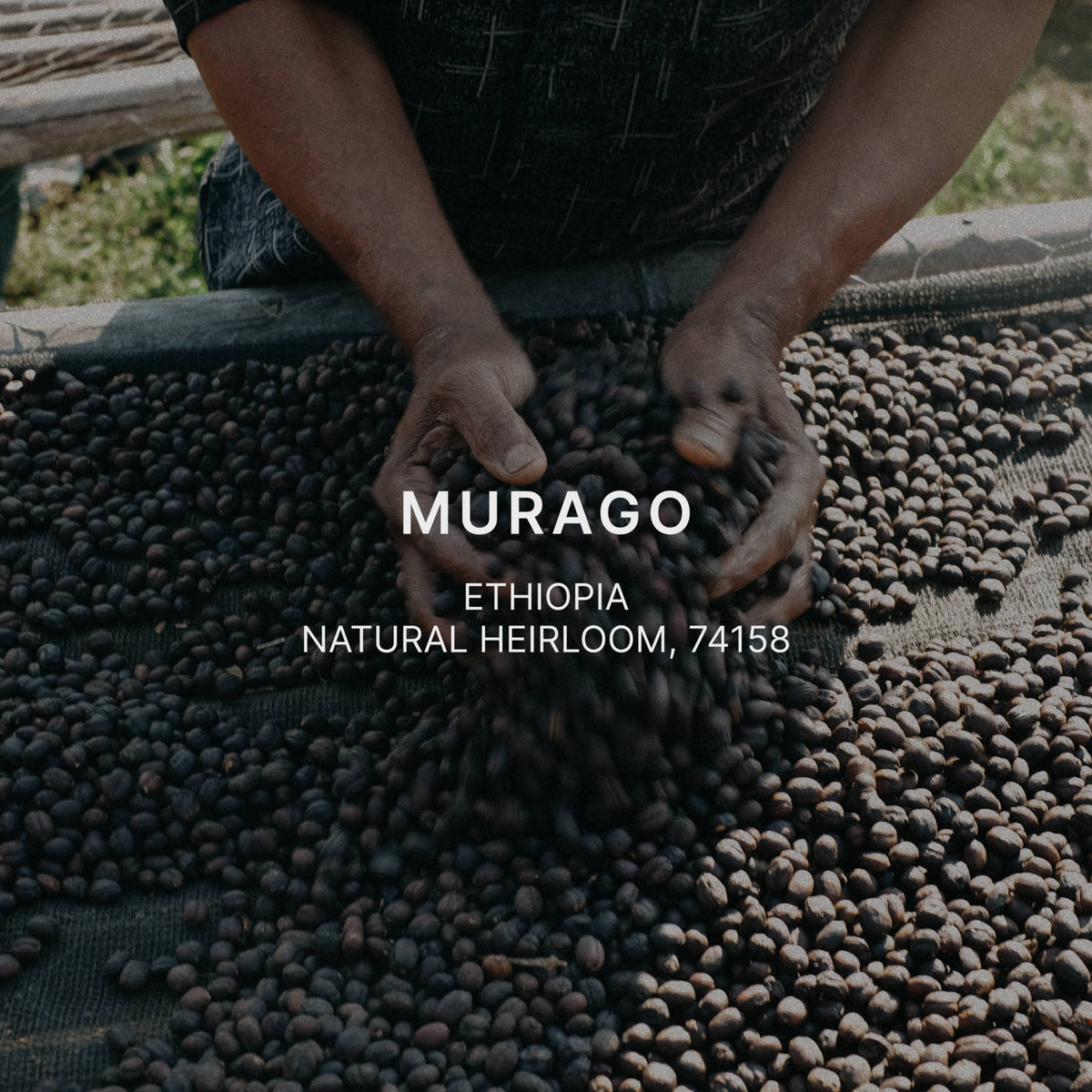
Bensa, Sidama, Ethiopia
ABOUT
Basha Bekele
Basha Bekele is one of the youngest and most driven coffee producers in the Bensa district of Sidama. Since 2021 he has built a network of high, cool farms across Murago, Kokose, Badagalo, and Gonjobe villages, all on rich nitisol soils between roughly 2350 and 2580 metres, and he runs his own dry mill in Bombe village. In 2024 his coffee won the Ethiopia Cup of Excellence, and in 2025 the Taste of Harvest, both from his own lots in Gonjobe. We have worked with him for three years, since before those wins, and we keep buying across his sites. The careful picking, floating, and slow drying show in cups that are clean, floral, and vividly fruited.
Ethiopian Heirloom
Ethiopian heirloom, sometimes written as mixed heirloom, is not a single named variety at all. It is the term used for the thousands of indigenous landrace types that grow across Ethiopia, the birthplace of Arabica coffee. Many of these plants have never been formally catalogued, and have instead been selected and passed down by farming families over countless generations, each one adapted to the exact hillside and altitude where it grows. This deep genetic diversity is a big part of what makes Ethiopian coffee so distinctive, giving cups that are floral and citric with a delicate tea like quality, bright acidity, and layered fruit that can shift from one village to the next.
JARC 74158
74158 is one of the improved varieties developed by the Jimma Agricultural Research Center in Ethiopia, released to give farmers a plant that could shrug off coffee berry disease while still cupping beautifully. The number itself tells the story, as the 74 marks the year it was catalogued, back in 1974. Up in the highlands of Sidama it is often grown and sold under the local landrace name Kurume, tended in the traditional garden system alongside food crops. Growers value it for being dependable in the field and expressive in the cup, giving clean, floral coffees with citrus and sweet berry in both washed and natural styles.
Natural
The natural process is the oldest way of preparing coffee, dating back to the earliest days of the crop in Ethiopia and Yemen. The whole cherry is dried intact, with the skin, pulp, and sticky mucilage all left on the bean, so as the fruit slowly dries it feeds its sugars and aromas straight into the seed. Getting it right takes patience and constant attention, as the cherries have to be turned regularly on raised beds over many days to dry evenly and avoid faults. Done well, the natural process gives coffees their heavy body, deep berry and jam fruit, and big, wine like sweetness.
Brewing recipes
Simple ways to brew with SOLO & SOLO SPIN

SOLO
This is the classic pour-over style.
You control the brew through your pouring technique, water temperature, and flow speed.
Each pour helps guide the extraction, from soaking the coffee evenly at the beginning to building sweetness in the middle and finishing clean at the end.
This method is best when you want a clean, balanced cup with direct control over the pour.
Best for a clean, balanced cup with direct control over the pour.
SOLO SPIN
This is a hybrid brewing style.
SOLO SPIN uses a valve to control when the coffee is soaking and when it is draining.
When the valve is closed, the coffee stays in contact with the water, like immersion brewing.When the valve is open, the water flows through the coffee, like percolation brewing.
This method gives you more control over contact time, sweetness, body, and clarity.It is best when you want a consistent, balanced cup with both the roundness of immersion and the clean finish of pour-over.
Best for a consistent, balanced cup — the roundness of immersion with the clean finish of pour-over.
SOLO
SOLO POUR OVER METHOD
This method is simple, clean, and easy to repeat.
Coffee does not extract all at once. Different flavors come out at different moments during the brew.
The first pour helps water reach all the coffee evenly.
The middle pours build sweetness, body, and balance.
The final pour should be gentle.
This helps avoid bitterness, dryness, and heavy flavors.The goal is not to push extraction harder.
The goal is to keep the cup sweet, clean, and structured.
3 POUR EXTRACTION
This method is best for a clean, sweet, and balanced cup.
At 0:00, pour 80g of water at 93°C.
Make sure all the coffee is fully wet. There should be no dry spots.
At 0:40, pour another 80g of water at 93°C.
This second pour builds sweetness and balance.
At 1:20, pour the final 80g of water at 85°C.
Pour gently and let the brew finish naturally.
4 POUR EXTRACTION
This method is best when you want more body and more structure.
At 0:00, pour 60g of water at 93°C.
Fully soak all the coffee.
At 0:30, pour another 60g of water at 93°C.
This helps build sweetness.
At 1:00, pour another 60g of water at 93°C.
This develops more body and structure.
At 1:30, pour the final 60g of water at 85°C.
Keep this pour gentle and centered.
8G DOSE EXTRACTION
Use this recipe when brewing rare, expensive, or limited coffees.
It is designed for a smaller cup, while keeping the same brewing idea.
Coffee: 8g
Water: 120g
Ratio: 1:15
Grind: Medium-coarse
minerals: 40-80 ppm
For the 3 pour method, pour 40g at 0:00, 40g at 0:40, and 40g at 1:20.
Use 93°C for the first two pours and 85°C for the final pour.
For the 4 pour method, pour 30g at 0:00, 30g at 0:30, 30g at 1:00, and 30g at 1:30.
Use 93°C for the first three pours and 85°C for the final pour.
This small dose method is useful when you want to enjoy a high-end coffee without using too much coffee at once.
SOLO SPIN
SOLO SPIN BREW METHOD
SOLO SPIN gives more control during brewing.
When the valve is closed, the coffee is soaking.
When the valve is open, the coffee is draining.
This lets you combine immersion and percolation in one simple brewer.
Immersion helps water reach the coffee evenly.
Drainage keeps the cup clean and clear.
The result is a sweet, balanced, and consistent brew.
TWO PHASE MOISTURE EXTRACTION
JACKIE'S COMPETITION RECIPE
This recipe was designed to be simple, consistent, and forgiving.
It has two phases.
The first phase is penetration.
This helps water reach every coffee particle evenly.
The second phase is development.
This slows the extraction down and builds sweetness, texture, clarity, and balance.
Coffee: 14g
Water: 200ml
Ratio: 1:14
minerals: 80 ppm
At 0:00, close the valve.
Add 100ml of water at 94°C.
Let the coffee soak.
At 1:00, open the valve and let it fully drain.
At 1:20, close the valve again.
Add 100ml of water at 80°C.
Let the coffee soak again.
At 2:20, open the valve and let it fully drain.
This is the most forgiving SOLO SPIN recipe and is perfect for daily brewing.
PIP EXTRACTION
Percolation. Immersion. Percolation.
Triple Pulse Brewing is a SOLO SPIN recipe.
It starts with percolation, then moves into immersion, and finishes with percolation again.
This creates a cup that is clean, sweet, and expressive.
Coffee: 14g
Water: 200ml
Ratio: 1:14
minerals: 80 ppm
At 0:00, start with the valve open.
Add 50ml of water at 80°C.
Let the water flow through the coffee.
This first percolation stage helps open the coffee and bring out aroma and clarity.
At 0:30, close the valve.
Add 100ml of water at 94°C.
Let the coffee soak.
This immersion stage builds sweetness, body, and balance.
At 1:00, open the valve.
Add the final 50ml of water at 80°C.
Let the brew drain completely.
This final percolation stage refines the cup and keeps the finish clean.
This recipe is best when you want a cup with both sweetness and clarity.
It gives the roundness of immersion, but still keeps the clean finish of percolation.
