
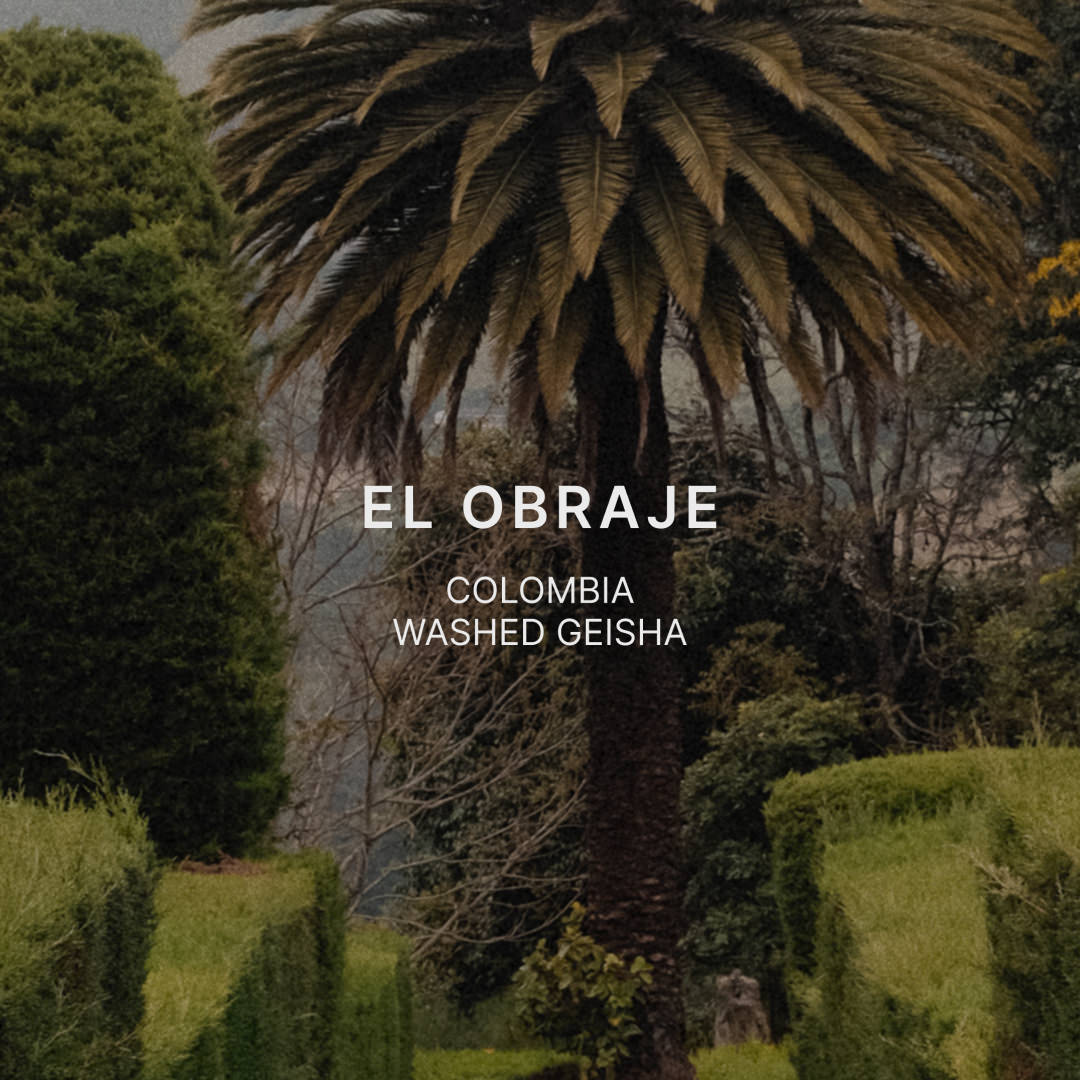
Tangua, Nariño, Colombia
ABOUT
Hacienda El Obraje
Hacienda El Obraje sits on the slope of a dormant volcano in Tangua, in the far south of Nariño, between 2000 and 2300 masl. For generations the Guerrero family grew wheat here. When cheap imports made grain unviable, Pablo Andrés Guerrero, an architect from Pasto, bet the land on coffee and was one of the first in the area to plant it. Of nearly 90 hectares he keeps only around 35 in coffee and has turned the rest into a natural forest reserve, planting trees to protect the microclimate of the whole farm. Days reach 32 °C at noon and nights fall to 8 °C or lower, and that swing builds dense beans with a clean, layered acidity. In 2021 his washed Geisha won the Colombia Cup of Excellence with 90.61 points, and his lots are still chosen by competitors around the world. We first roasted El Obraje in 2023 and keep coming back.
Geisha
Geisha, also spelled Gesha, traces its roots to the forests of southwestern Ethiopia, where the original seed was collected in the middle of the twentieth century before travelling through research collections in Central America. For decades it was little more than a curiosity, until growers working at high altitude discovered how extraordinary it could taste. At its best it is unmistakable, with intense florality, a delicate tea like quality, bright citrus, and tropical fruit. The plants are slender and shy to yield and offer little disease resistance, so Geisha is demanding to grow and slow to crop, which is exactly why truly great examples stay rare and so highly prized.
Washed
The washed process is the cleanest and most precise way to prepare coffee, and the one that lets a single origin and variety speak most clearly. Every trace of fruit and sticky mucilage is stripped away before the bean is dried, usually by fermenting it loose in tanks and rinsing it off with water, or by scrubbing it away mechanically. Because no fruit is left touching the bean as it dries, nothing masks the raw character of the coffee itself. That is why the washed method is trusted for the finest lots, showing off clarity, bright lively acidity, and the clear stamp of where the coffee was grown.
Brewing recipes
Simple ways to brew with SOLO & SOLO SPIN

SOLO
This is the classic pour-over style.
You control the brew through your pouring technique, water temperature, and flow speed.
Each pour helps guide the extraction, from soaking the coffee evenly at the beginning to building sweetness in the middle and finishing clean at the end.
This method is best when you want a clean, balanced cup with direct control over the pour.
Best for a clean, balanced cup with direct control over the pour.
SOLO SPIN
This is a hybrid brewing style.
SOLO SPIN uses a valve to control when the coffee is soaking and when it is draining.
When the valve is closed, the coffee stays in contact with the water, like immersion brewing.When the valve is open, the water flows through the coffee, like percolation brewing.
This method gives you more control over contact time, sweetness, body, and clarity.It is best when you want a consistent, balanced cup with both the roundness of immersion and the clean finish of pour-over.
Best for a consistent, balanced cup — the roundness of immersion with the clean finish of pour-over.
SOLO
SOLO POUR OVER METHOD
This method is simple, clean, and easy to repeat.
Coffee does not extract all at once. Different flavors come out at different moments during the brew.
The first pour helps water reach all the coffee evenly.
The middle pours build sweetness, body, and balance.
The final pour should be gentle.
This helps avoid bitterness, dryness, and heavy flavors.The goal is not to push extraction harder.
The goal is to keep the cup sweet, clean, and structured.
3 POUR EXTRACTION
This method is best for a clean, sweet, and balanced cup.
At 0:00, pour 80g of water at 93°C.
Make sure all the coffee is fully wet. There should be no dry spots.
At 0:40, pour another 80g of water at 93°C.
This second pour builds sweetness and balance.
At 1:20, pour the final 80g of water at 85°C.
Pour gently and let the brew finish naturally.
4 POUR EXTRACTION
This method is best when you want more body and more structure.
At 0:00, pour 60g of water at 93°C.
Fully soak all the coffee.
At 0:30, pour another 60g of water at 93°C.
This helps build sweetness.
At 1:00, pour another 60g of water at 93°C.
This develops more body and structure.
At 1:30, pour the final 60g of water at 85°C.
Keep this pour gentle and centered.
8G DOSE EXTRACTION
Use this recipe when brewing rare, expensive, or limited coffees.
It is designed for a smaller cup, while keeping the same brewing idea.
Coffee: 8g
Water: 120g
Ratio: 1:15
Grind: Medium-coarse
minerals: 40-80 ppm
For the 3 pour method, pour 40g at 0:00, 40g at 0:40, and 40g at 1:20.
Use 93°C for the first two pours and 85°C for the final pour.
For the 4 pour method, pour 30g at 0:00, 30g at 0:30, 30g at 1:00, and 30g at 1:30.
Use 93°C for the first three pours and 85°C for the final pour.
This small dose method is useful when you want to enjoy a high-end coffee without using too much coffee at once.
SOLO SPIN
SOLO SPIN BREW METHOD
SOLO SPIN gives more control during brewing.
When the valve is closed, the coffee is soaking.
When the valve is open, the coffee is draining.
This lets you combine immersion and percolation in one simple brewer.
Immersion helps water reach the coffee evenly.
Drainage keeps the cup clean and clear.
The result is a sweet, balanced, and consistent brew.
TWO PHASE MOISTURE EXTRACTION
JACKIE'S COMPETITION RECIPE
This recipe was designed to be simple, consistent, and forgiving.
It has two phases.
The first phase is penetration.
This helps water reach every coffee particle evenly.
The second phase is development.
This slows the extraction down and builds sweetness, texture, clarity, and balance.
Coffee: 14g
Water: 200ml
Ratio: 1:14
minerals: 80 ppm
At 0:00, close the valve.
Add 100ml of water at 94°C.
Let the coffee soak.
At 1:00, open the valve and let it fully drain.
At 1:20, close the valve again.
Add 100ml of water at 80°C.
Let the coffee soak again.
At 2:20, open the valve and let it fully drain.
This is the most forgiving SOLO SPIN recipe and is perfect for daily brewing.
PIP EXTRACTION
Percolation. Immersion. Percolation.
Triple Pulse Brewing is a SOLO SPIN recipe.
It starts with percolation, then moves into immersion, and finishes with percolation again.
This creates a cup that is clean, sweet, and expressive.
Coffee: 14g
Water: 200ml
Ratio: 1:14
minerals: 80 ppm
At 0:00, start with the valve open.
Add 50ml of water at 80°C.
Let the water flow through the coffee.
This first percolation stage helps open the coffee and bring out aroma and clarity.
At 0:30, close the valve.
Add 100ml of water at 94°C.
Let the coffee soak.
This immersion stage builds sweetness, body, and balance.
At 1:00, open the valve.
Add the final 50ml of water at 80°C.
Let the brew drain completely.
This final percolation stage refines the cup and keeps the finish clean.
This recipe is best when you want a cup with both sweetness and clarity.
It gives the roundness of immersion, but still keeps the clean finish of percolation.